
TheRetroArcade
Veteran
Posts: 11,729
Joined: Feb 2026
Joined: Feb 2026
I’ve always found the “ah ha!” moments of game development yield some of the most interesting stories, because that moment of inspiration can come in many forms — and when you least expect it. It could happen on a stroll in the park, in the middle of the grocery store, or in the case of Kiln, while looking at clay pots on the Internet.
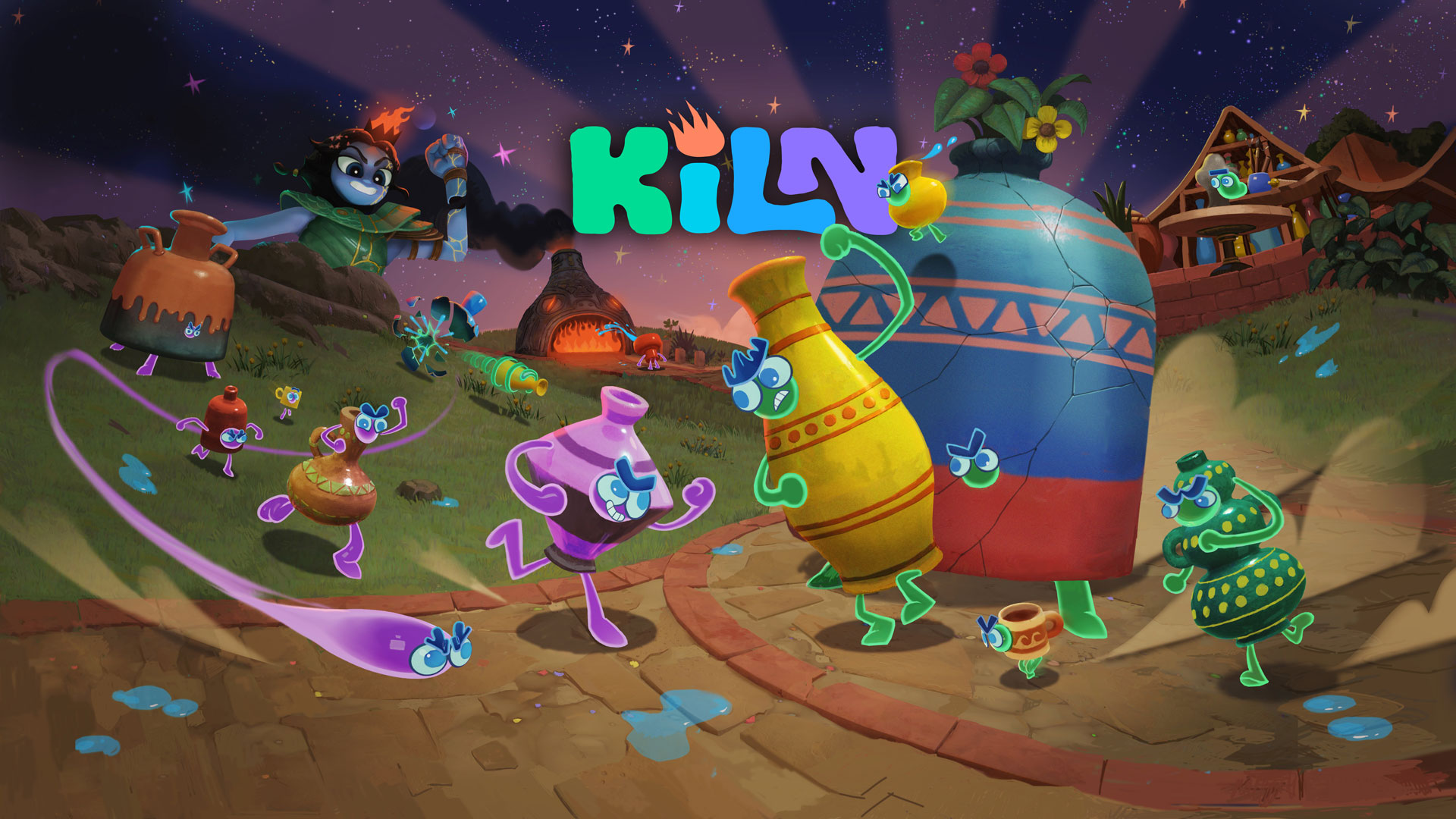
“I had this idea of clay molding in the back of my head ever since I had come across some pictures of pots when I was online researching something else,” Project Lead Derek Brand tells me. “It immediately stood out to me that there’s a lot of variety in pots, and you could probably make that on a controller because it’s more of a 2D kind of representation. Then it all started snapping into place from there, and I had a pitch for the next Amnesia Fortnight. It kind of came together at the last minute.”
Amnesia Fortnights are semi-annual game jam events that Double Fine holds internally with members of its studio. Here they’re given a limited amount of time, a fortnight (two weeks), to turn the inkling of an idea into a playable game – this is when Derek pitched his idea to bring Kiln to life. “I played a lot of action games at the time, and I wanted to make my little clay characters fight someone else’s little clay characters. I was thinking that’d be fun — and so that was in the back of my mind — but didn’t know how to do that on a controller.”
One of the many fun details Derek revealed was that as development started to kick off in earnest, the team at Double Fine started to take pottery classes in real life, which contributed to understanding all the different elements involved in the making of pottery. That’s when the ideas really started to flow.
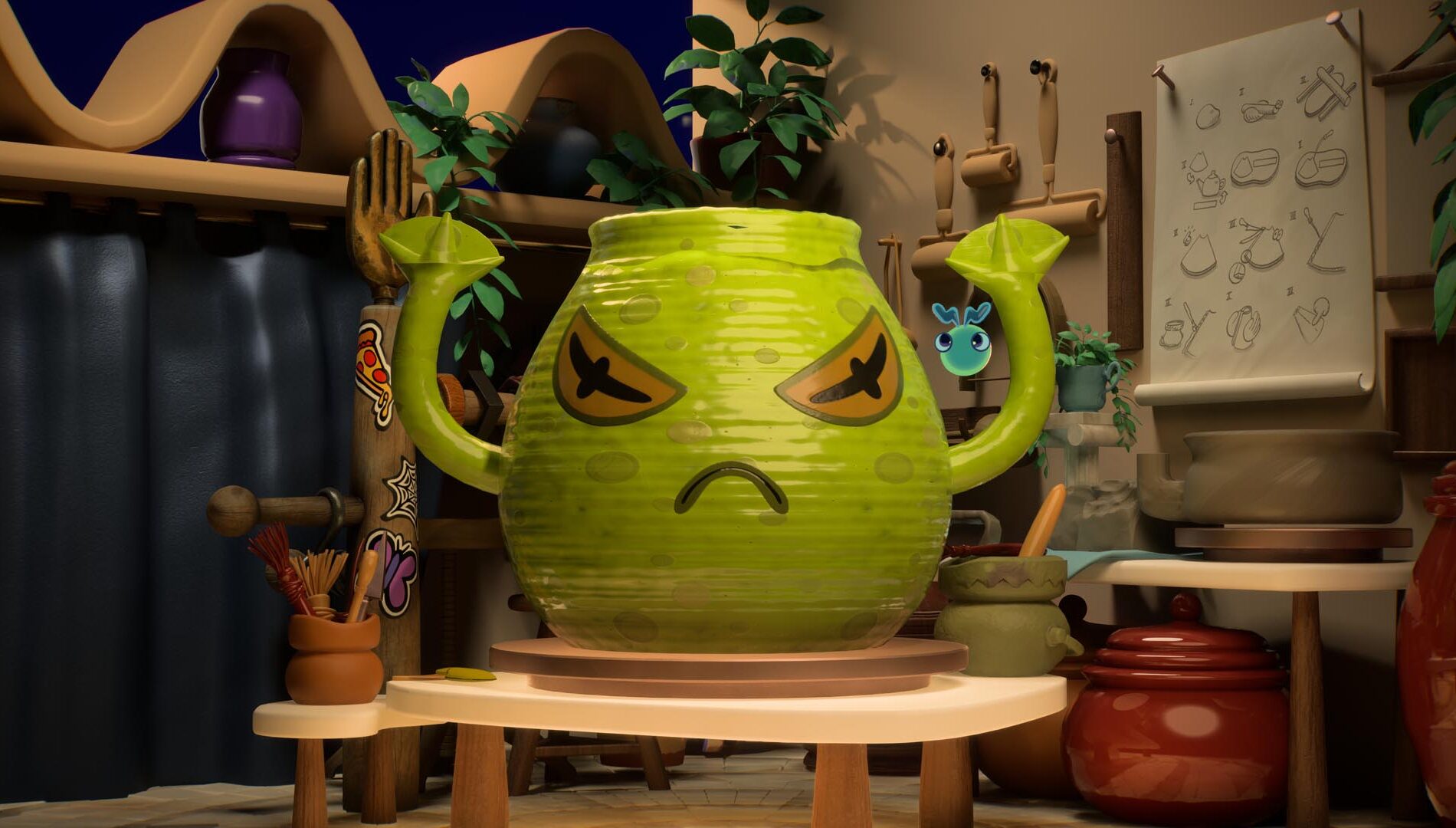
“There are a whole world of techniques and processes and so much raw material to pull into the game, that once we were like, ‘Okay, you can sculpt a character,’ there’s so much more you can do with clay. And all those ideas just piled on,” Brand explains. “We spent a long time talking about your basic shape, but now I want to dip it into glaze — to glaze a pot you take a pair of metal tongs and you dunk it into a bucket of glaze — and really trying to pull those pieces of real-life pot making into the game and introducing those ideas to players.”
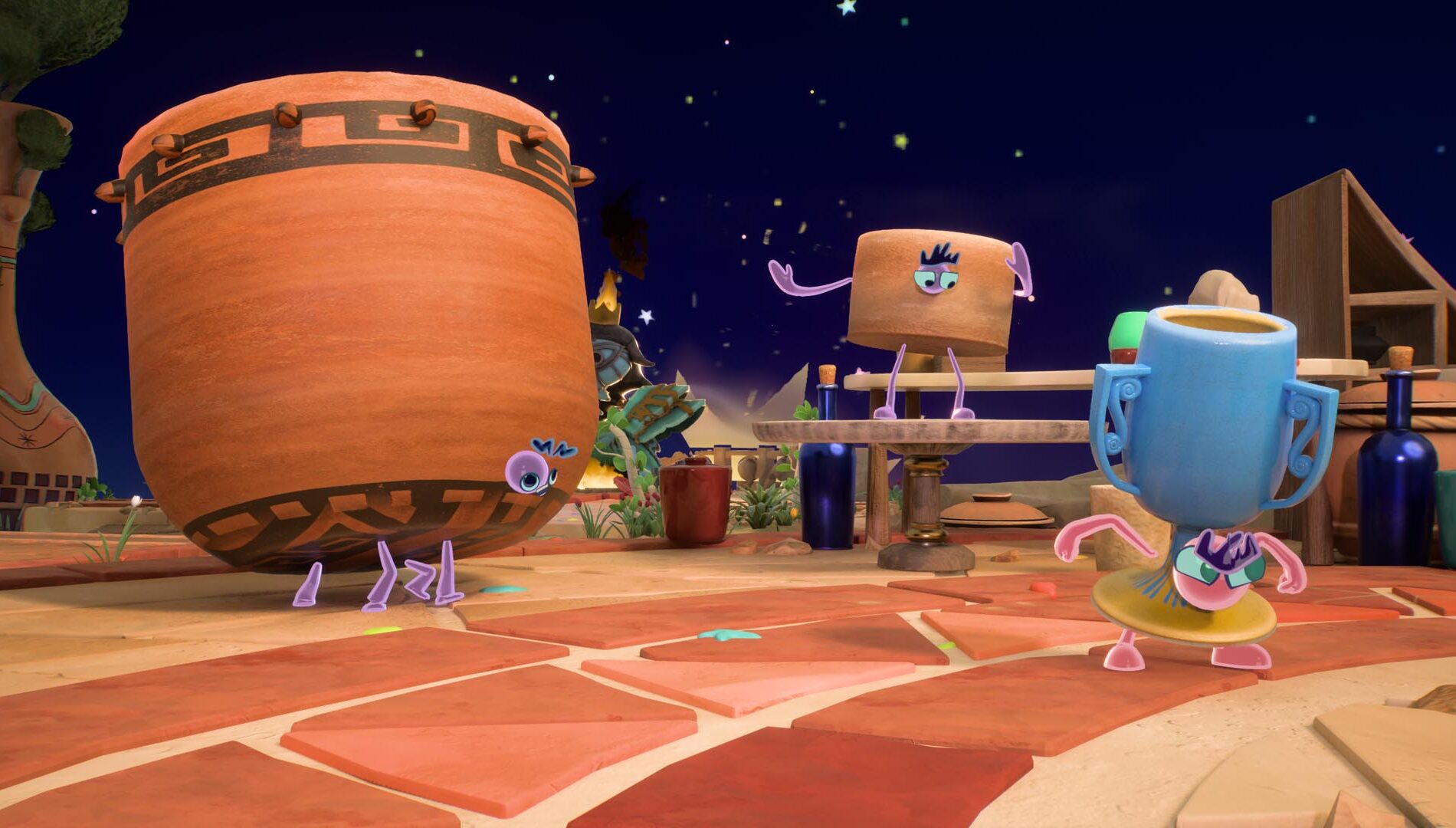
From there, more ideas came about in terms of how a player could customize their pot beyond its basic shape. From sticking on handles, lids and spouts, and even getting a little sillier by adding stickers, there are countless different ways you can take a basic clay pot and really make it your own. “It all came down to research and ideas from people on the team and then having a pile of those ideas and whittling them all down to something that is coherent and well designed,” Brand says.
But how do you translate a difficult hobby like clay pot making into a competitive multiplayer game? Ensuring it’s as approachable as possible. “After the Amnesia Fortnight prototype, we got through that part and a lot of the initial ideas of, ‘I can make a character on the wheel like a pottery wheel’ — that initial thought was naive on my part. I had taken ceramics in college and learned a little bit about pot making, but it was more of a way to fit character creation onto a controller.”
By using a controller, you can move your little spirit hands up and down the shape of the clay as it rotates on a virtual turning wheel. In addition, you have access to several shaping tools that can bring another level of detail to the pot creation. As I touched on in my first look at the game, it didn’t take long for me to get the hang of it – it all felt very natural when given a few minutes of time with clay molding tools. I get the impression players will be able to engage with this creative aspect of Kiln just as easily.
When asking Derek if he had any tips for the budding clay pot maker in all of us, it was simple. “Don’t be scared. Don’t be precious with it,” he tells me. “Try a bunch of stuff and figure out what you like be...Read more: Full article on news.xbox.com
What do you think about this?
“I had this idea of clay molding in the back of my head ever since I had come across some pictures of pots when I was online researching something else,” Project Lead Derek Brand tells me. “It immediately stood out to me that there’s a lot of variety in pots, and you could probably make that on a controller because it’s more of a 2D kind of representation. Then it all started snapping into place from there, and I had a pitch for the next Amnesia Fortnight. It kind of came together at the last minute.”
Amnesia Fortnights are semi-annual game jam events that Double Fine holds internally with members of its studio. Here they’re given a limited amount of time, a fortnight (two weeks), to turn the inkling of an idea into a playable game – this is when Derek pitched his idea to bring Kiln to life. “I played a lot of action games at the time, and I wanted to make my little clay characters fight someone else’s little clay characters. I was thinking that’d be fun — and so that was in the back of my mind — but didn’t know how to do that on a controller.”
One of the many fun details Derek revealed was that as development started to kick off in earnest, the team at Double Fine started to take pottery classes in real life, which contributed to understanding all the different elements involved in the making of pottery. That’s when the ideas really started to flow.
“There are a whole world of techniques and processes and so much raw material to pull into the game, that once we were like, ‘Okay, you can sculpt a character,’ there’s so much more you can do with clay. And all those ideas just piled on,” Brand explains. “We spent a long time talking about your basic shape, but now I want to dip it into glaze — to glaze a pot you take a pair of metal tongs and you dunk it into a bucket of glaze — and really trying to pull those pieces of real-life pot making into the game and introducing those ideas to players.”
From there, more ideas came about in terms of how a player could customize their pot beyond its basic shape. From sticking on handles, lids and spouts, and even getting a little sillier by adding stickers, there are countless different ways you can take a basic clay pot and really make it your own. “It all came down to research and ideas from people on the team and then having a pile of those ideas and whittling them all down to something that is coherent and well designed,” Brand says.
But how do you translate a difficult hobby like clay pot making into a competitive multiplayer game? Ensuring it’s as approachable as possible. “After the Amnesia Fortnight prototype, we got through that part and a lot of the initial ideas of, ‘I can make a character on the wheel like a pottery wheel’ — that initial thought was naive on my part. I had taken ceramics in college and learned a little bit about pot making, but it was more of a way to fit character creation onto a controller.”
By using a controller, you can move your little spirit hands up and down the shape of the clay as it rotates on a virtual turning wheel. In addition, you have access to several shaping tools that can bring another level of detail to the pot creation. As I touched on in my first look at the game, it didn’t take long for me to get the hang of it – it all felt very natural when given a few minutes of time with clay molding tools. I get the impression players will be able to engage with this creative aspect of Kiln just as easily.
When asking Derek if he had any tips for the budding clay pot maker in all of us, it was simple. “Don’t be scared. Don’t be precious with it,” he tells me. “Try a bunch of stuff and figure out what you like be...Read more: Full article on news.xbox.com
What do you think about this?