
TheRetroArcade
Veteran
Posts: 11,909
Joined: Feb 2026
Joined: Feb 2026
Glaive expectations

Writing about new 2D timeloop metroidvania Echo Weaver is tricky because most - possibly all - of what you need to complete it is available to you the very second you first wake up, deep in the charnelpools of an ethereal and shattered lunar civilisation.
The plot in brief: you are a perpetually rewinding robot boy on a mission to work out what the hell happened. You'll explore overgrown biomes, investigate busted machines, run errands for a handful of scrappy, splashy-hued aliens, and conjure holographic flashbacks that cover the circumstances of your own creation. Developers Moonlight Kids stress that the only thing you really gain in the course of all this is knowledge. There are a few upgrades to gather, but no core skills to unlock. Instead, it's all there for you to learn, whether by reaching a tutorial area or just by hitting buttons at random and messing with terrain fixtures.
As such, my telling you about abilities really does risk ruining it, much like explaining the behaviour of celestial bodies in Echo Weaver's great influence, Outer Wilds. So if you're strongly inclined to buy the game – my verdict after four hours: a vivid and thoughtful, freeform Metroidy puzzler with refreshingly minimal combat and a few rough edges - maybe get your feet wet before reading on.
Still here? Right then, let's reset the loop and take things from the top.

In Echo Weaver, time is a flexible, edible resource. The loop starts out titchy, giving you a minute to act, but you can add bars to the timeline by gathering blue crystals, which are plentiful near the starting area. The loop has a maximum duration that encompasses a variety of events such as automated doors sealing shut and boulders falling: it's fun, working out how to be where you need to be when, though it's nothing like as seismic as the recurring chain of celestial transformations you get in Outer Wilds.
You can also actively burn time, disintegrating one bar in order to restore your health, but given the relative scarcity of enemies, this is seldom necessary. In general, you do not need to worry hugely about finding crystals, as long as you follow the given platforming routes. There are a few, distant regions where crystals are harder to come by, requiring you to farm a bit before making the expedition, but in my experience, you're most at risk of running short when you get too carried away with your glaive.
The glaive is your primary tool. You can throw it horizontally or vertically. You can toss and catch it like a boomerang to kill things, smash detritus, and scoop up crystals. Or you can lob it with full force to send it hurtling off-screen. When lobbed, the glaive flies in a straight line until it either lodges in something or reaches the very summit of the playable area, at which point it'll tumble back down. You can recall it to your hand by holding a button. Might not sound that useful, but here's the thing: there is a way of teleporting to the glaive's position.
Sometimes the game limits the associated possibilities by building puzzle layouts around them. For example: chuck the glaive down a pipe, in order to warp behind a laser barrier. But a lot of the world is open air, a vast, lurid volume pockmarked by floating islands and plants. When scuttling about under the game's purple sky, there's always the temptation to throw the glaive up at random and see what you discover.
Sometimes, you pop out into an astral thorn bush, and tumble to your doom: the game rather artificially slides Winged Fortress Zone-style instadeath barriers under really high altitude sections, rather than letting you plummet all the way. Other times, though, you find yourself in an endgame section, having bypassed a load of platforming and puzzling, including tutorials for new moves and an evolving thread of lore.
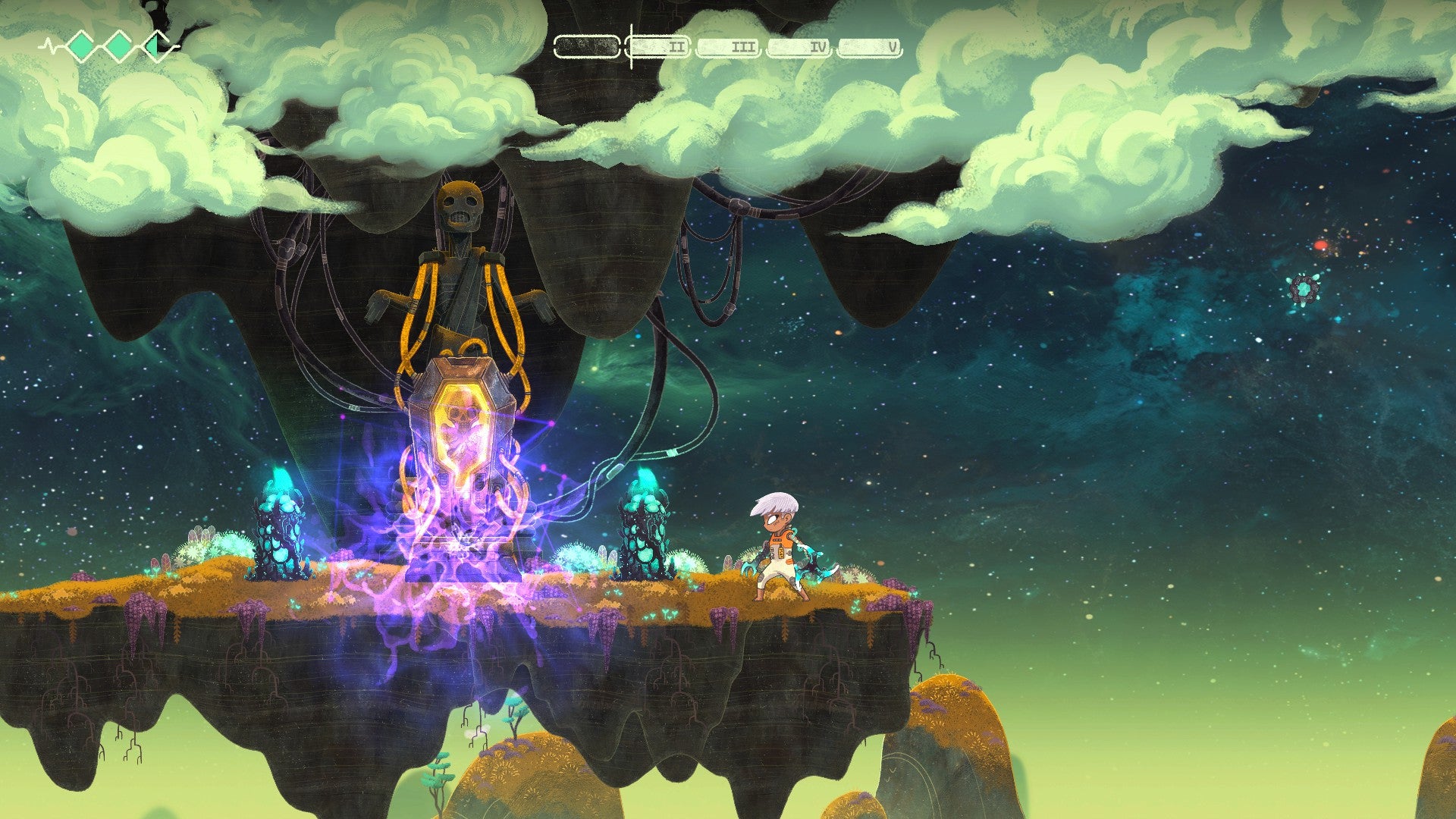
I admire the game's commitment to letting you 'break' it. Essentially, the glaive transforms you into the rook in chess, able to move any distance along ...Read more: Full article on www.rockpapershotgun.com
What do you think about this?
Writing about new 2D timeloop metroidvania Echo Weaver is tricky because most - possibly all - of what you need to complete it is available to you the very second you first wake up, deep in the charnelpools of an ethereal and shattered lunar civilisation.
The plot in brief: you are a perpetually rewinding robot boy on a mission to work out what the hell happened. You'll explore overgrown biomes, investigate busted machines, run errands for a handful of scrappy, splashy-hued aliens, and conjure holographic flashbacks that cover the circumstances of your own creation. Developers Moonlight Kids stress that the only thing you really gain in the course of all this is knowledge. There are a few upgrades to gather, but no core skills to unlock. Instead, it's all there for you to learn, whether by reaching a tutorial area or just by hitting buttons at random and messing with terrain fixtures.
As such, my telling you about abilities really does risk ruining it, much like explaining the behaviour of celestial bodies in Echo Weaver's great influence, Outer Wilds. So if you're strongly inclined to buy the game – my verdict after four hours: a vivid and thoughtful, freeform Metroidy puzzler with refreshingly minimal combat and a few rough edges - maybe get your feet wet before reading on.
Still here? Right then, let's reset the loop and take things from the top.
In Echo Weaver, time is a flexible, edible resource. The loop starts out titchy, giving you a minute to act, but you can add bars to the timeline by gathering blue crystals, which are plentiful near the starting area. The loop has a maximum duration that encompasses a variety of events such as automated doors sealing shut and boulders falling: it's fun, working out how to be where you need to be when, though it's nothing like as seismic as the recurring chain of celestial transformations you get in Outer Wilds.
You can also actively burn time, disintegrating one bar in order to restore your health, but given the relative scarcity of enemies, this is seldom necessary. In general, you do not need to worry hugely about finding crystals, as long as you follow the given platforming routes. There are a few, distant regions where crystals are harder to come by, requiring you to farm a bit before making the expedition, but in my experience, you're most at risk of running short when you get too carried away with your glaive.
The glaive is your primary tool. You can throw it horizontally or vertically. You can toss and catch it like a boomerang to kill things, smash detritus, and scoop up crystals. Or you can lob it with full force to send it hurtling off-screen. When lobbed, the glaive flies in a straight line until it either lodges in something or reaches the very summit of the playable area, at which point it'll tumble back down. You can recall it to your hand by holding a button. Might not sound that useful, but here's the thing: there is a way of teleporting to the glaive's position.
Sometimes the game limits the associated possibilities by building puzzle layouts around them. For example: chuck the glaive down a pipe, in order to warp behind a laser barrier. But a lot of the world is open air, a vast, lurid volume pockmarked by floating islands and plants. When scuttling about under the game's purple sky, there's always the temptation to throw the glaive up at random and see what you discover.
Sometimes, you pop out into an astral thorn bush, and tumble to your doom: the game rather artificially slides Winged Fortress Zone-style instadeath barriers under really high altitude sections, rather than letting you plummet all the way. Other times, though, you find yourself in an endgame section, having bypassed a load of platforming and puzzling, including tutorials for new moves and an evolving thread of lore.
I admire the game's commitment to letting you 'break' it. Essentially, the glaive transforms you into the rook in chess, able to move any distance along ...Read more: Full article on www.rockpapershotgun.com
What do you think about this?