
TheRetroArcade
Veteran
Posts: 11,265
Joined: Feb 2026
Joined: Feb 2026
A walk in the dark
A narrative-heavy RPG with moments of brilliance that never quite come together.
Nighthawks, the 1942 painting by Edward Hopper, is generally described as portraying loneliness. The four people at the diner counter are dwarfed by the empty, cold openness of the street. But the inside of the diner looks warm. One man sits apart, but the other two patrons might be a couple, their hands . The worker seems to be watching them, perhaps thinking of somebody he’ll return to after his shift. Nighthawks, the 2026 vampire RPG, takes this same sensation, connection in the middle of isolation, and plays it much less subtly. When it works, it manages to tell sub-stories that will stick with me like the glow of a friendly building late at night.
But it doesn’t always work.

Not so long ago, it was revealed to the world that vampires are real. You step into the shoes of a newly-made blood drinker, who quickly rises to being the most important person in the city via taking over the titular Nighthawks nightclub. Every evening, you’ll be able to explore locations across three neighbourhoods, the down-and-out Cradlebridge, the red light district Angelbreach, and the upper class area of Fountaincourt. There you’ll find dozens of miniature stories waiting for you to navigate using your levelable traits (like brawling and seduction) and special skills (mine was being able to get an echo of the past from a dead body).
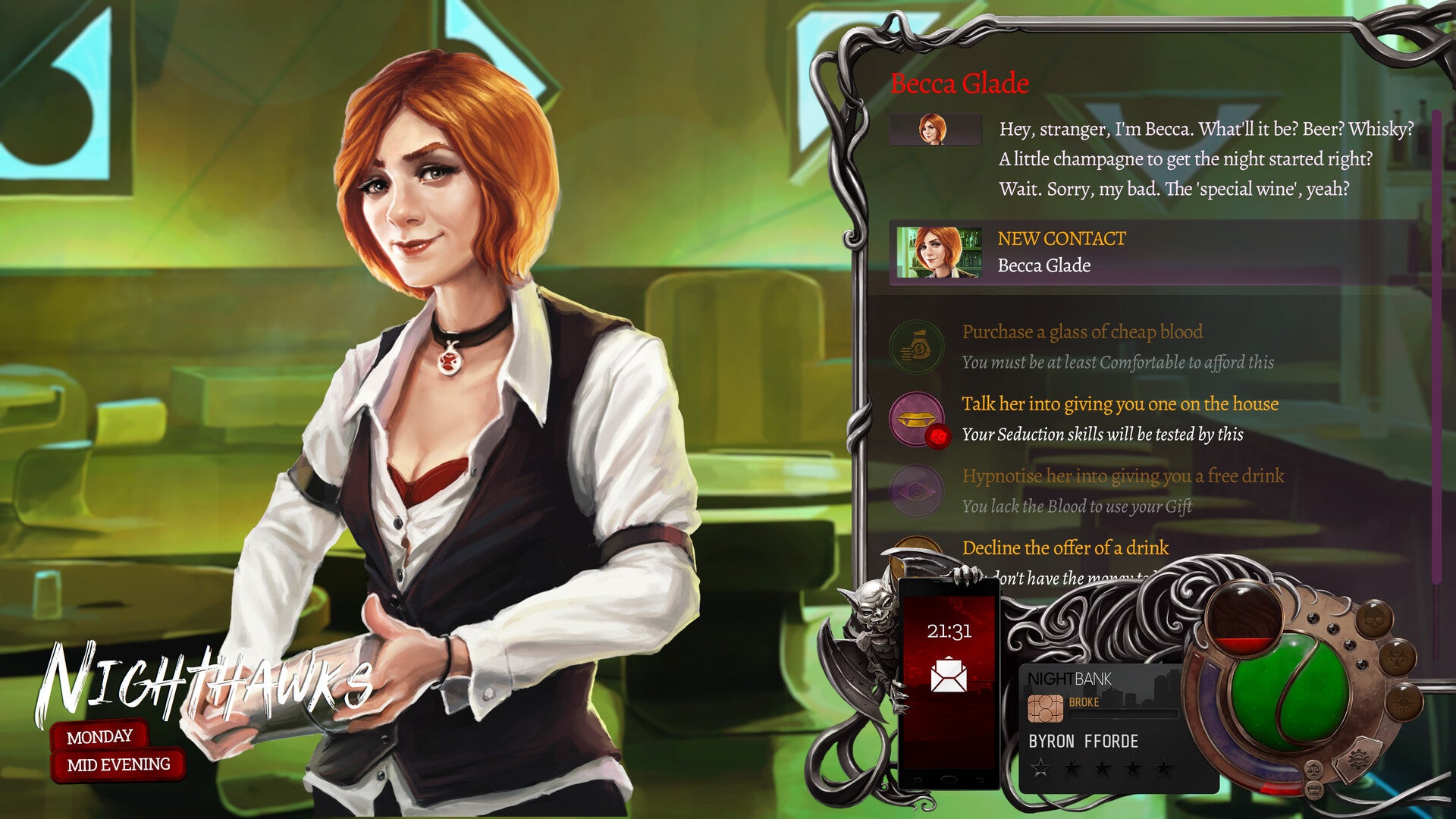
Nighthawks lives and dies (and lives again) by its narrative. While the painterly backdrops, characterful portraits and occasional flavourful sound effect give the city some depth and flair, and the music is catchy, they aren’t what you are here for, and they don’t pretend to be. (Portraits, for example, are often reused to sketch the impression of generic tertiary characters, and the music is perhaps so catchy because it is so often the same.) That said, they do come together to give a memorable overall flavour of the city: acidic blood, grime tracked across floors by heavy boots, a tension that spills over every night.
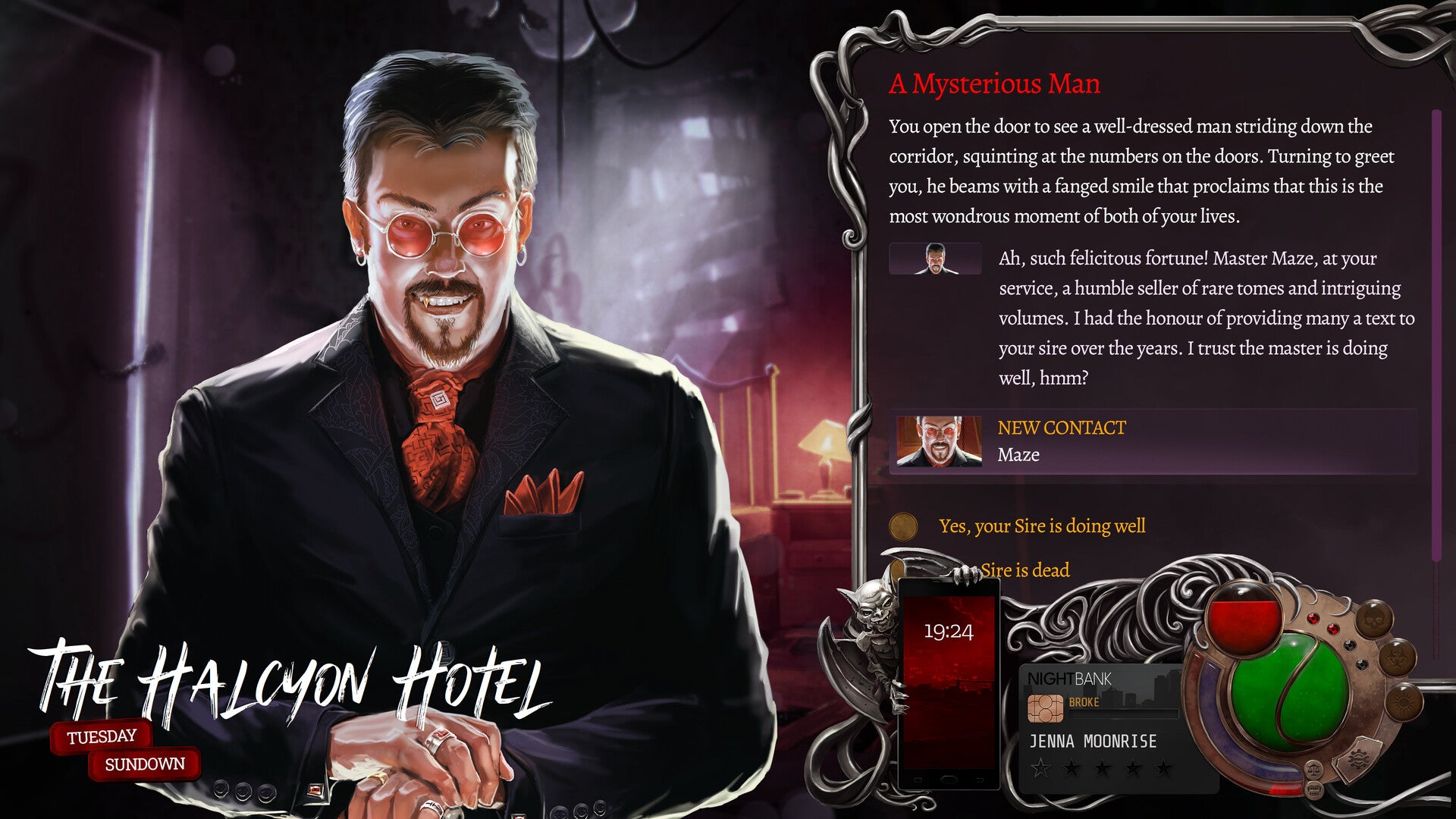
But most of the narrative comes in the form of vignettes spread across five acts; even though the main story builds on itself, it still feels separated into individual slices. Some of these vignettes are outstanding. Two in particular come to mind, both of which involve freeing two very different women from restrictive obligations. They resonate because of how they weave this ancient theme into Nighthawks’ specific setting: one feels hundreds of years old because the vampire at its centre is exactly that aged, and has never been able to escape that old cultural hold – but it’s still relevant because of how those systems play out today. The other is skeweringly modern both in allegory and because in fiction it relies on the fact that vampires have only recently become known to the general public, so relations between night- and daywalkers are still being hashed out.
But where these two stories work, they also illustrate where Nighthawks as a whole falters. These stand out because they take an old oppression and make it interesting by examining it with the game’s new twist. The same can’t be said for anti-vampire sentiment, which is one of the few threads that tries to tie together the game’s overall arc. Although there are human supremacist groups and mobs wandering the streets and can randomly attack you, it doesn’t come across as especially convincing, especially because you yourself quickly become so powerful that they aren’t much of a concern. And this part of the narrative also struggles with a common issue when stories make up an oppressed group: vampires are dangerous.
It also doesn’t help that the two standout quests I mentioned earlier come relatively together, in the game’s broadly good middle. As well as never managing to pull these better subplots into a satisfying whole, the game takes a long time to get going. The first act is particularly dry, as Nighthawks depends on ...Read more: Full article on www.rockpapershotgun.com
What do you think about this?
A narrative-heavy RPG with moments of brilliance that never quite come together.
Nighthawks, the 1942 painting by Edward Hopper, is generally described as portraying loneliness. The four people at the diner counter are dwarfed by the empty, cold openness of the street. But the inside of the diner looks warm. One man sits apart, but the other two patrons might be a couple, their hands . The worker seems to be watching them, perhaps thinking of somebody he’ll return to after his shift. Nighthawks, the 2026 vampire RPG, takes this same sensation, connection in the middle of isolation, and plays it much less subtly. When it works, it manages to tell sub-stories that will stick with me like the glow of a friendly building late at night.
But it doesn’t always work.
Not so long ago, it was revealed to the world that vampires are real. You step into the shoes of a newly-made blood drinker, who quickly rises to being the most important person in the city via taking over the titular Nighthawks nightclub. Every evening, you’ll be able to explore locations across three neighbourhoods, the down-and-out Cradlebridge, the red light district Angelbreach, and the upper class area of Fountaincourt. There you’ll find dozens of miniature stories waiting for you to navigate using your levelable traits (like brawling and seduction) and special skills (mine was being able to get an echo of the past from a dead body).
Nighthawks lives and dies (and lives again) by its narrative. While the painterly backdrops, characterful portraits and occasional flavourful sound effect give the city some depth and flair, and the music is catchy, they aren’t what you are here for, and they don’t pretend to be. (Portraits, for example, are often reused to sketch the impression of generic tertiary characters, and the music is perhaps so catchy because it is so often the same.) That said, they do come together to give a memorable overall flavour of the city: acidic blood, grime tracked across floors by heavy boots, a tension that spills over every night.
But most of the narrative comes in the form of vignettes spread across five acts; even though the main story builds on itself, it still feels separated into individual slices. Some of these vignettes are outstanding. Two in particular come to mind, both of which involve freeing two very different women from restrictive obligations. They resonate because of how they weave this ancient theme into Nighthawks’ specific setting: one feels hundreds of years old because the vampire at its centre is exactly that aged, and has never been able to escape that old cultural hold – but it’s still relevant because of how those systems play out today. The other is skeweringly modern both in allegory and because in fiction it relies on the fact that vampires have only recently become known to the general public, so relations between night- and daywalkers are still being hashed out.
But where these two stories work, they also illustrate where Nighthawks as a whole falters. These stand out because they take an old oppression and make it interesting by examining it with the game’s new twist. The same can’t be said for anti-vampire sentiment, which is one of the few threads that tries to tie together the game’s overall arc. Although there are human supremacist groups and mobs wandering the streets and can randomly attack you, it doesn’t come across as especially convincing, especially because you yourself quickly become so powerful that they aren’t much of a concern. And this part of the narrative also struggles with a common issue when stories make up an oppressed group: vampires are dangerous.
It also doesn’t help that the two standout quests I mentioned earlier come relatively together, in the game’s broadly good middle. As well as never managing to pull these better subplots into a satisfying whole, the game takes a long time to get going. The first act is particularly dry, as Nighthawks depends on ...Read more: Full article on www.rockpapershotgun.com
What do you think about this?