
TheRetroArcade
Veteran
Posts: 13,488
Joined: Feb 2026
Joined: Feb 2026
We PC gamers are far from the belle of the AI ball.
When you purchase through links on our site, we may earn an affiliate commission. Here’s how it works.
Jensen Huang has resigned from his position as Nvidia CEO. That's such an odd sentence to write, as a huge part of my career as a tech journalist has revolved around covering Nvidia, its graphics cards, and undoubtedly, its leather-jacketed chief.
As I write this article, I'm already seeing reaction on social media from PC gamers. Some are shocked, some are indifferent, and some appear to be celebrating. In terms of the latter, I'd imagine that's because the ex-Nvidia boss has become one of the most recognisable figures behind the great AI revolution, which, err, isn't popular within our hobby, to say the least.
Not only that, but RAM is ludicrously expensive, with storage not far behind. And graphics cards, Nvidia's gaming bread and butter? The price increases recently have been mind-boggling. All of these things are, in the main, AI server-demand induced, and Nvidia is behind the chips that power most of those servers, making vast amounts of money in the process.
And so on that level, I can understand why some might cheer his departure, equating the company's figurehead with Nvidia's new place in the AI economy as a whole—leaving us gamers in the lurch. But as far as I see it, Jensen Huang leaving the helm of Nvidia is unlikely to be a good thing for PC gaming.
I'll give you an unfortunate percentage: 7.4%. That's roughly how much of Nvidia's total revenue was brought in by gaming in the 2026 fiscal year. The company reported $193.7 billion in data center revenue. Its gaming division? $16 billion. That's despite the fact the company is estimated to hold 90% of the PC graphics card market share.
In terms of business fundamentals, Nvidia would be foolish to put more focus on gaming hardware while the AI cash cow continues to provide. Huang, however, still seemed reluctant to leave PC gaming entirely by the wayside during his tenure.
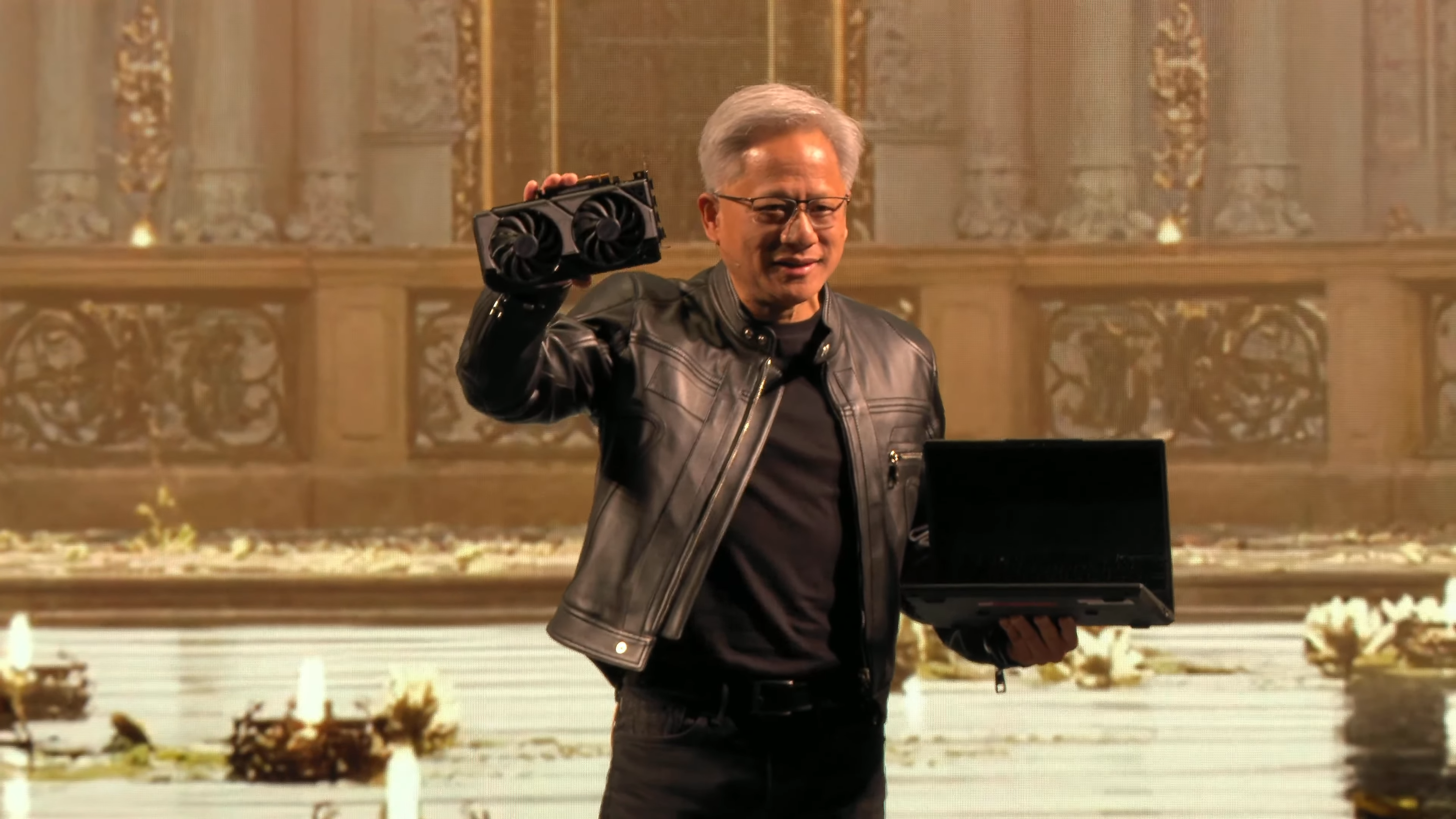
Those who have watched as many Nvidia GPU announcements as I have will know that walking on stage with a new graphics card, or gaming laptop, lit up Huang's face the most. 3D graphics was where the company began, after all, back when founders Jensen Huang, Chris Malachowsky, and Curtis Priem sat down at a Dennys in San Jose and put together a business plan. Or so the story goes.
The PC Gamer Circuit Breaker newsletter breaks down the latest PC gaming tech, and finds you the best deals on the best products
But now, someone new will be steering the ship. Colette Kress, the company's executive vice president and chief financial officer will serve as interim CEO, while the search begins for Huang's permanent replacement.
Whoever they are, they'll be taking over an absolute titan of tech, the behemoth standing behind the US position in the great AI race, and a company that will need to convince its investors that the AI good times are far from over. How big a factor do you think consumer graphics cards are likely to be in those discussions?
Personally, I reckon they're going to be pretty far down the list of priorities. Because this is big business, money talks, and AI data centers are where most of the cash still lies. I wish that wasn't true, but the figures speak for themselves.
So, if Nvidia pivots even further away from gaming hardware, where might your next graphics card come from? There's always AMD, who's CEO has recently proudly declared it as "a data center-first company." Hmm, I'm not too confident on the focus there, either. Or Intel, which... oh jeez, you too?
I'm not saying consumer gaming hardware, or Nvidia graphics cards, are going to disappear entirely in the face of the AI onslaught. But what I am saying is that, love him or loathe him, Jensen Huang was still an advocate for PC gaming—at least out of sentimentality, if nothing else.
He who became one of the primary movers of the AI market now threatening our hobby, wa...Read more: Full article on www.pcgamer.com
What do you think about this?
When you purchase through links on our site, we may earn an affiliate commission. Here’s how it works.
Jensen Huang has resigned from his position as Nvidia CEO. That's such an odd sentence to write, as a huge part of my career as a tech journalist has revolved around covering Nvidia, its graphics cards, and undoubtedly, its leather-jacketed chief.
As I write this article, I'm already seeing reaction on social media from PC gamers. Some are shocked, some are indifferent, and some appear to be celebrating. In terms of the latter, I'd imagine that's because the ex-Nvidia boss has become one of the most recognisable figures behind the great AI revolution, which, err, isn't popular within our hobby, to say the least.
Not only that, but RAM is ludicrously expensive, with storage not far behind. And graphics cards, Nvidia's gaming bread and butter? The price increases recently have been mind-boggling. All of these things are, in the main, AI server-demand induced, and Nvidia is behind the chips that power most of those servers, making vast amounts of money in the process.
And so on that level, I can understand why some might cheer his departure, equating the company's figurehead with Nvidia's new place in the AI economy as a whole—leaving us gamers in the lurch. But as far as I see it, Jensen Huang leaving the helm of Nvidia is unlikely to be a good thing for PC gaming.
I'll give you an unfortunate percentage: 7.4%. That's roughly how much of Nvidia's total revenue was brought in by gaming in the 2026 fiscal year. The company reported $193.7 billion in data center revenue. Its gaming division? $16 billion. That's despite the fact the company is estimated to hold 90% of the PC graphics card market share.
In terms of business fundamentals, Nvidia would be foolish to put more focus on gaming hardware while the AI cash cow continues to provide. Huang, however, still seemed reluctant to leave PC gaming entirely by the wayside during his tenure.
Those who have watched as many Nvidia GPU announcements as I have will know that walking on stage with a new graphics card, or gaming laptop, lit up Huang's face the most. 3D graphics was where the company began, after all, back when founders Jensen Huang, Chris Malachowsky, and Curtis Priem sat down at a Dennys in San Jose and put together a business plan. Or so the story goes.
The PC Gamer Circuit Breaker newsletter breaks down the latest PC gaming tech, and finds you the best deals on the best products
But now, someone new will be steering the ship. Colette Kress, the company's executive vice president and chief financial officer will serve as interim CEO, while the search begins for Huang's permanent replacement.
Whoever they are, they'll be taking over an absolute titan of tech, the behemoth standing behind the US position in the great AI race, and a company that will need to convince its investors that the AI good times are far from over. How big a factor do you think consumer graphics cards are likely to be in those discussions?
Personally, I reckon they're going to be pretty far down the list of priorities. Because this is big business, money talks, and AI data centers are where most of the cash still lies. I wish that wasn't true, but the figures speak for themselves.
So, if Nvidia pivots even further away from gaming hardware, where might your next graphics card come from? There's always AMD, who's CEO has recently proudly declared it as "a data center-first company." Hmm, I'm not too confident on the focus there, either. Or Intel, which... oh jeez, you too?
I'm not saying consumer gaming hardware, or Nvidia graphics cards, are going to disappear entirely in the face of the AI onslaught. But what I am saying is that, love him or loathe him, Jensen Huang was still an advocate for PC gaming—at least out of sentimentality, if nothing else.
He who became one of the primary movers of the AI market now threatening our hobby, wa...Read more: Full article on www.pcgamer.com
What do you think about this?