
TheRetroArcade
Veteran
Posts: 11,732
Joined: Feb 2026
Joined: Feb 2026
Investigating the RPG's detective systems.

When you purchase through links on our site, we may earn an affiliate commission. Here’s how it works.
I have technically solved a lot of crimes from the comfort of my gaming chair, but it's surprisingly rare for games to actually engage with the mechanics of a criminal investigation. You'll chat to folk, maybe use your 'detective vision', and then the culprit is found. Warhammer 40,000: Dark Heresy asks more from you.
As an agent of the Inquisition, solving crimes and putting away heretics is your business. You don't complete quests, you solve cases, log evidence, make accusations, torture and snoop—all in a universe where your word is law.
Owlcat's given us a quick breakdown of Dark Heresy's detective systems in the video above, but like my favourite inquisitor, Gregor Eisenhorn, I wanted to dig a little deeper and put some questions to Veronika Larionova, Owlcat's senior narrative designer.
It's hard to come up with something completely new in a genre that's been around for so long. We drew inspiration from all sorts of games and books, and classic detective elements—like clue cards and the detective board they're arranged on—are, I think, familiar to everyone. But we tried to put together a system that would work in harmony with one of the core pillars of our games: the narrative.
Piecing together deductions from evidence, relying on companions, examining crime scenes, and reconstructing the events that took place there—all of this will be familiar to players, but we hope we managed to make it feel uniquely our own.
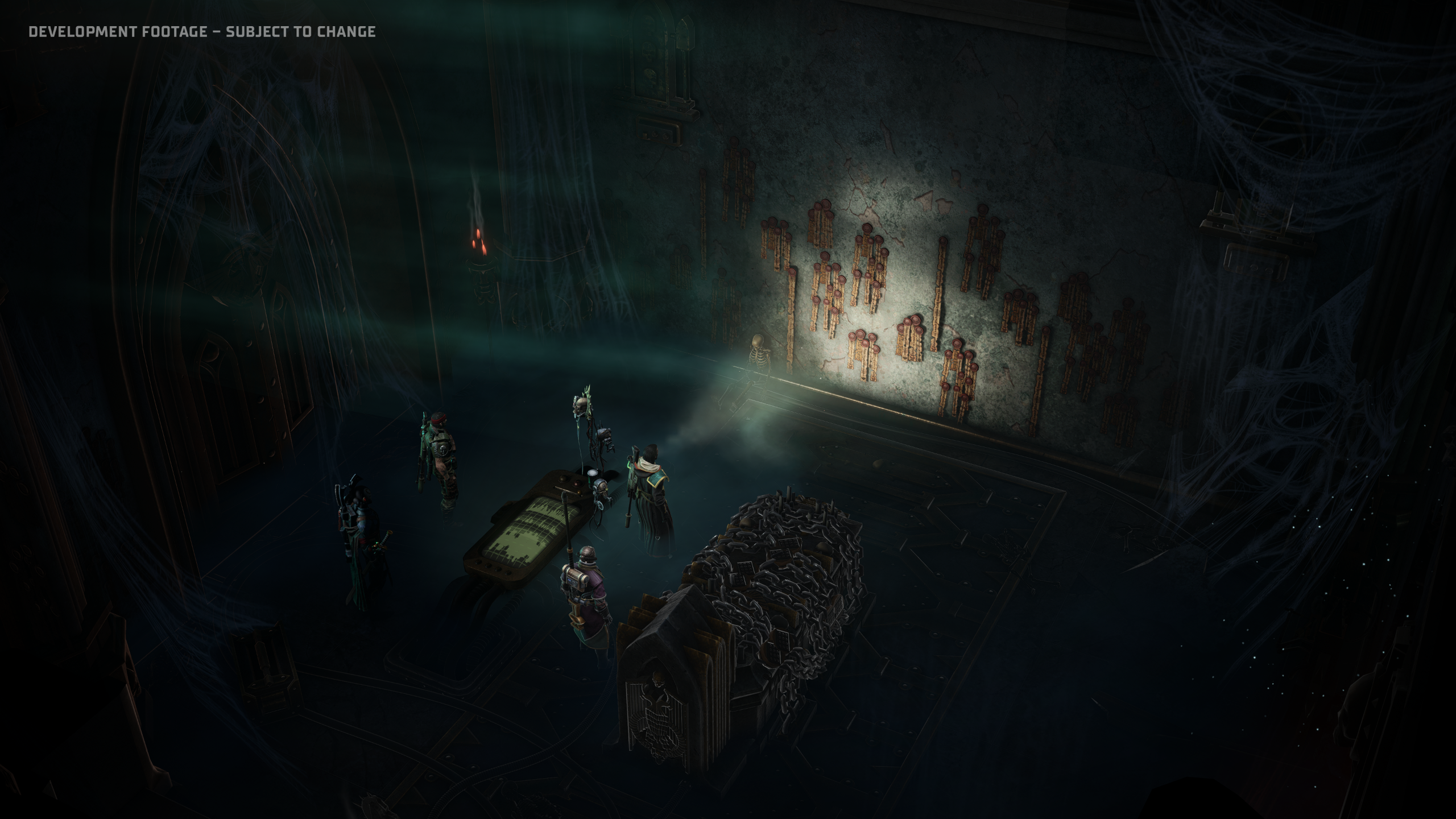
Besides your own mind and intuition, you mean? Well, every inquisitor has their own approach. As an acolyte, you'll be able to use your detective journal to gather, sort, and store evidence. There's also the Servo-Ossuarium—a rare device made up of several servo-skull assistants capable of tracking suspicious trails, intercepting signals, and running various kinds of data analysis. There will be other devices too, shared with you by other inquisitors.

And, of course, your companions, who bring their own unique knowledge and experience.
Companions are always ready to share their expertise, but none of them can solve a mystery on their own. Sometimes they help gather evidence during conversations with suspects, or suggest alternative solutions to the problems facing the acolyte. It's important to remember that companions are offering you their personal opinion, and whether to factor it in or disregard it is entirely up to you.
Absolutely, yes. You are an agent of the Golden Throne, an acolyte of the Inquisition, and your word is undeniable truth. You can accuse any suspect in a case the moment you log evidence against them in your inquisitorial journal. Even if all you have is the feeling that they're breathing a little oddly.
That said, if you keep digging into the investigation, you'll also find that new evidence or conclusions can reshape the wording of the accusation, adding more detail and proof. Or, conversely, turn up evidence clearing the suspect. What you do with that information is entirely up to you.
The fact that your verdict is treated as truth doesn't mean uncovering the actual truth is unimportant (though it isn't mandatory). It simply means that the power to use that truth as you see fit rests in your hands.
If we're talking about solving what actually happened, that depends entirely on the specific case.
Sometimes you'll need to build a whole chain of deductions to arrive at the truth. But luck is a tool no worse than deduction, and sometimes a "blind shot," fired because your gut told you to, can hit the mark exactly.
So yes, from time to time you won't be able to avoid situations where the world's—and the NPCs'—reaction depends on the evidence you've gathered.
For the world, the correct answer is whichever one you choose as an acolyte of the Inquisition. Sometimes it opens up a new story branch, sometimes it earns you some kind of rewar...Read more: Full article on www.pcgamer.com
What do you think about this?
When you purchase through links on our site, we may earn an affiliate commission. Here’s how it works.
I have technically solved a lot of crimes from the comfort of my gaming chair, but it's surprisingly rare for games to actually engage with the mechanics of a criminal investigation. You'll chat to folk, maybe use your 'detective vision', and then the culprit is found. Warhammer 40,000: Dark Heresy asks more from you.
As an agent of the Inquisition, solving crimes and putting away heretics is your business. You don't complete quests, you solve cases, log evidence, make accusations, torture and snoop—all in a universe where your word is law.
Owlcat's given us a quick breakdown of Dark Heresy's detective systems in the video above, but like my favourite inquisitor, Gregor Eisenhorn, I wanted to dig a little deeper and put some questions to Veronika Larionova, Owlcat's senior narrative designer.
It's hard to come up with something completely new in a genre that's been around for so long. We drew inspiration from all sorts of games and books, and classic detective elements—like clue cards and the detective board they're arranged on—are, I think, familiar to everyone. But we tried to put together a system that would work in harmony with one of the core pillars of our games: the narrative.
Piecing together deductions from evidence, relying on companions, examining crime scenes, and reconstructing the events that took place there—all of this will be familiar to players, but we hope we managed to make it feel uniquely our own.
Besides your own mind and intuition, you mean? Well, every inquisitor has their own approach. As an acolyte, you'll be able to use your detective journal to gather, sort, and store evidence. There's also the Servo-Ossuarium—a rare device made up of several servo-skull assistants capable of tracking suspicious trails, intercepting signals, and running various kinds of data analysis. There will be other devices too, shared with you by other inquisitors.
And, of course, your companions, who bring their own unique knowledge and experience.
Companions are always ready to share their expertise, but none of them can solve a mystery on their own. Sometimes they help gather evidence during conversations with suspects, or suggest alternative solutions to the problems facing the acolyte. It's important to remember that companions are offering you their personal opinion, and whether to factor it in or disregard it is entirely up to you.
Absolutely, yes. You are an agent of the Golden Throne, an acolyte of the Inquisition, and your word is undeniable truth. You can accuse any suspect in a case the moment you log evidence against them in your inquisitorial journal. Even if all you have is the feeling that they're breathing a little oddly.
That said, if you keep digging into the investigation, you'll also find that new evidence or conclusions can reshape the wording of the accusation, adding more detail and proof. Or, conversely, turn up evidence clearing the suspect. What you do with that information is entirely up to you.
The fact that your verdict is treated as truth doesn't mean uncovering the actual truth is unimportant (though it isn't mandatory). It simply means that the power to use that truth as you see fit rests in your hands.
If we're talking about solving what actually happened, that depends entirely on the specific case.
Sometimes you'll need to build a whole chain of deductions to arrive at the truth. But luck is a tool no worse than deduction, and sometimes a "blind shot," fired because your gut told you to, can hit the mark exactly.
So yes, from time to time you won't be able to avoid situations where the world's—and the NPCs'—reaction depends on the evidence you've gathered.
For the world, the correct answer is whichever one you choose as an acolyte of the Inquisition. Sometimes it opens up a new story branch, sometimes it earns you some kind of rewar...Read more: Full article on www.pcgamer.com
What do you think about this?