
TheRetroArcade
Veteran
Posts: 12,437
Joined: Feb 2026
Joined: Feb 2026
Molleindustria called on ChatGPT and Claude for a "tiny fraction" of code
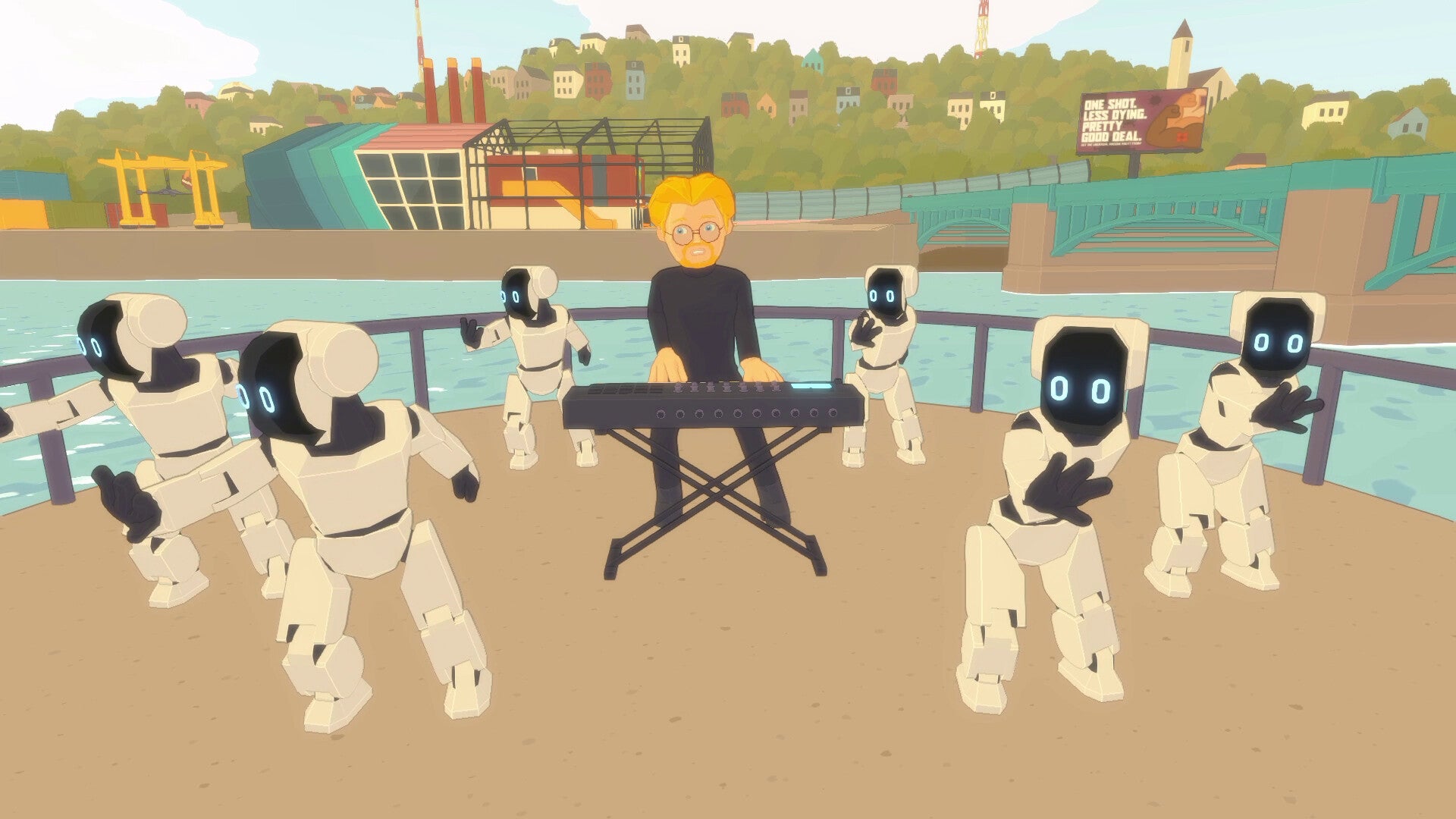
Prominent capital-p Political game developer and left-wing academic Paulo "Molleindustria" Pedercini has revealed that he used generative AI tools for aspects of recent ecosocialist satire Future? No Thanks!. According to Pedercini, "a tiny fraction of its code was written with AI support" towards the end of the project, specifically to assess and fix bugs.
The game also uses text-to-speech voice-acting for a couple of characters, generated with ElevenLab software, with Pedercini noting that the characters in question are intended as a spoof of wonky artificial intelligence. He insists that none of the game's art or writing is AI-generated. These insights arrive weeks after the game's Steam release, which was delayed due to Valve's concerns about sexual material. Back then, there was no genAI disclosure on the game's storepage. There is one now.
Pedercini fessed up about using generative AI on his blog yesterday. "Every independent gaming festival and showcase in the year 2026 requires some kind of generative AI disclosure," he begins. "That is great! Slop and vibe-coded games are a scourge, AI is a technofascist, anti-human and anti-art project, and it’s imperative to create spaces of resistance.
"Future? No Thanks! is a game that tackles the impact and limits of artificial intelligence head-on," Pedercini continues. "It satirizes generative AI and the careless ways it can be used, even in an enlightened ecosocialist world. It also dramatizes beneficial uses, such as coordinating a planned economy, voice recognition, and talking robots. And yet, I can’t say it’s a 100% AI free game."
In a breakdown of development of Future! No Thanks, stretching back to 2021, Pedercini comments that "99% of its code base was written before AI was even viable as a coding tool". As for why he decided to use it during the closing stages, he argues that "ChatGPT or Claude" can be "a powerful semantic search engine" when fixing bugs.

"Search engines have been enshittified to death, specific technical queries don’t yield meaningful results anymore," Pedercini writes. "Most search engines produce low quality AI responses anyway. Such coding assistance was used for things like fixing a shader I didn’t write which broke after an update, or diagnosing a one-frame loading glitch when loading sequences. Finishing touches and minor debugging.
"Unlike assets that can be easily swapped, AI generated code is hard to remove once introduced," he goes on. "I wouldn’t be able to tell which lines I wrote, which were generated, and which were somewhere in between."
Regarding the game's voicework, Pedercini argues that "text-to-speech used to be an uncontroversial technology and an early application of neural networks. Then the AI bros started commercializing AI voices as a way to replace human actors, so it’s now problematic."
Apparently, Future? No Thanks! features "about two minutes" of generated voicework "for an automated toilet and a personal assistant that mis-translates Roman idioms". Pedercini spells out that "the humor of these scenes relies on uncanny voices doing their job poorly". The Future? No Thanks! team experimented with human voices for these roles, he adds, but found "they just weren’t working as well". He includes a clip of the PA character for reference.
Early demos of the game also featured some AI-generated "fake doo-woop tunes" with "AI" in the lyrics that "were supposed to make fun of losers who listen to slop". The referencing of AI in the lyrics was "conceived as a kind of mandatory watermark this future society imposes to AI-generated music," Pedercini explains. "I thought they were hilarious, but over time the association with a plagiarist tech company started to bother me so I replaced them with royalty free loops. By the way, royalty free samples that are certainly AI-free are increasingly hard to find, but I found an old site untouched since 2016."

...Read more: Full article on www.rockpapershotgun.com
What do you think about this?
Prominent capital-p Political game developer and left-wing academic Paulo "Molleindustria" Pedercini has revealed that he used generative AI tools for aspects of recent ecosocialist satire Future? No Thanks!. According to Pedercini, "a tiny fraction of its code was written with AI support" towards the end of the project, specifically to assess and fix bugs.
The game also uses text-to-speech voice-acting for a couple of characters, generated with ElevenLab software, with Pedercini noting that the characters in question are intended as a spoof of wonky artificial intelligence. He insists that none of the game's art or writing is AI-generated. These insights arrive weeks after the game's Steam release, which was delayed due to Valve's concerns about sexual material. Back then, there was no genAI disclosure on the game's storepage. There is one now.
Pedercini fessed up about using generative AI on his blog yesterday. "Every independent gaming festival and showcase in the year 2026 requires some kind of generative AI disclosure," he begins. "That is great! Slop and vibe-coded games are a scourge, AI is a technofascist, anti-human and anti-art project, and it’s imperative to create spaces of resistance.
"Future? No Thanks! is a game that tackles the impact and limits of artificial intelligence head-on," Pedercini continues. "It satirizes generative AI and the careless ways it can be used, even in an enlightened ecosocialist world. It also dramatizes beneficial uses, such as coordinating a planned economy, voice recognition, and talking robots. And yet, I can’t say it’s a 100% AI free game."
In a breakdown of development of Future! No Thanks, stretching back to 2021, Pedercini comments that "99% of its code base was written before AI was even viable as a coding tool". As for why he decided to use it during the closing stages, he argues that "ChatGPT or Claude" can be "a powerful semantic search engine" when fixing bugs.
"Search engines have been enshittified to death, specific technical queries don’t yield meaningful results anymore," Pedercini writes. "Most search engines produce low quality AI responses anyway. Such coding assistance was used for things like fixing a shader I didn’t write which broke after an update, or diagnosing a one-frame loading glitch when loading sequences. Finishing touches and minor debugging.
"Unlike assets that can be easily swapped, AI generated code is hard to remove once introduced," he goes on. "I wouldn’t be able to tell which lines I wrote, which were generated, and which were somewhere in between."
Regarding the game's voicework, Pedercini argues that "text-to-speech used to be an uncontroversial technology and an early application of neural networks. Then the AI bros started commercializing AI voices as a way to replace human actors, so it’s now problematic."
Apparently, Future? No Thanks! features "about two minutes" of generated voicework "for an automated toilet and a personal assistant that mis-translates Roman idioms". Pedercini spells out that "the humor of these scenes relies on uncanny voices doing their job poorly". The Future? No Thanks! team experimented with human voices for these roles, he adds, but found "they just weren’t working as well". He includes a clip of the PA character for reference.
Early demos of the game also featured some AI-generated "fake doo-woop tunes" with "AI" in the lyrics that "were supposed to make fun of losers who listen to slop". The referencing of AI in the lyrics was "conceived as a kind of mandatory watermark this future society imposes to AI-generated music," Pedercini explains. "I thought they were hilarious, but over time the association with a plagiarist tech company started to bother me so I replaced them with royalty free loops. By the way, royalty free samples that are certainly AI-free are increasingly hard to find, but I found an old site untouched since 2016."
...Read more: Full article on www.rockpapershotgun.com
What do you think about this?